

If you’re considering enrolling in a law school, you’ve probably asked yourself: How much does it cost, and is it worth it? It’s not just you. You may be the first person in your family to attend law school or you may have inherited a legacy of professional prestige, but pursuing a law degree comes with high expectations and high costs.
Law school can be expensive, and it’s easy to underestimate its true cost. In many cases, tuition numbers you see online do not tell the whole story. The hidden cost of lost income while studying full-time, along with living costs and fees, makes it more than just about your choice of law school. It’s about how strategically you approach the investment.
So this is why understanding the full picture is critical before applying. This article breaks down the true cost of law school and explains whether the degree truly pays off. So let’s get started.
Key Takeaways
- Tuition is only part of the cost. Law school tuition ranges from $31,000 (public in-state) to $58,000 (private) per year.
- Living expenses raise total costs significantly. Annual Cost of Attendance reaches $54,000–$83,500 once housing, food, and personal expenses are included
- Hidden costs add up. Bar preparation, licensing, clothing, and technology may increase by $10,000-15,000 in three years
- Most students rely on loans. The median law graduate owes more than 130,000.
- Repayment is sharp with interest. Six-figure loans may increase to $300,000 or more in 20-25 years
- Debt influences long-term decisions. Monthly payments are usually more than 2,000, which restricts career and life flexibility.
Breakdown Law School Tuition Fees for Me
While the legal profession is one of the prestigious ones, the financial burden it poses on students makes it less attractive. Tuition fees continue to rise, along with high interest rates, and salaries vary widely depending on where you graduate and where you work.
Fees vary according to private or public colleges, which we will discuss later on. To give you a rough estimate of the recent Cost of Attendance of Law Schools by LawHub data, here is what students are expected to pay just for their tuition fees:
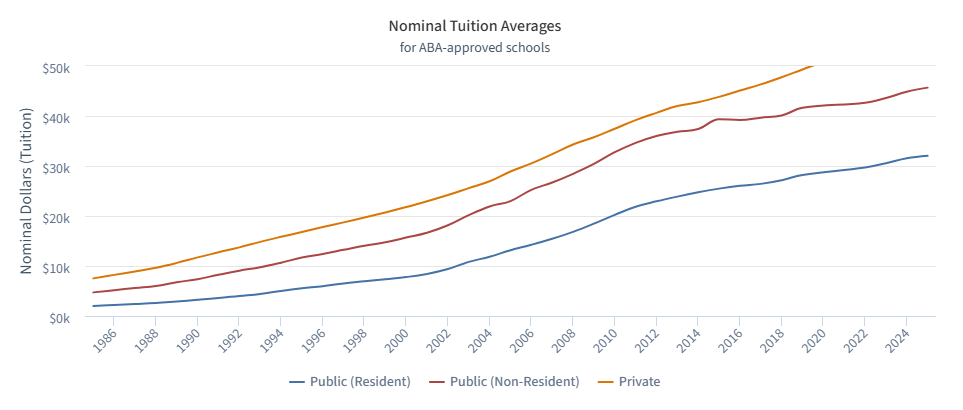
- Public law schools (in-state students): $31,430
- Public law schools (out-of-state students): $45,208
- Private law schools: $58,001
Source: LawHub
In addition to this cost, there are also living expenses like rent, food, transportation and personal expenses. Living expenses on average total $79,391, or $26,464 per year.
What’s the Difference Between Private vs Public Law Schools?
As seen from the data, the private schools cost significantly more than the public ones. Mainly because private schools do not receive state funding. Public law schools are partially subsidized by state governments, which lowers tuition for in-state residents. Private institutions must rely almost entirely on tuition, donations, and endowment income to cover their operating costs.
Another major factor is higher operating expenses. Private schools pay higher salaries to the faculty, have smaller classes and invest in recruiting and career placement offices, which builds into the student cost.
For example, Harvard Law School, a private institution, charges approximately $82,560 per year in tuition. Its total annual cost of attendance rises to about $116,000–$121,000 once you include food, rent, hostel and transportation fees. In comparison, if you take a public school, Wayne State University Law School, it has a $67,000 fee for in-state students, including tuition and living expenses. This comparison highlights how state subsidies at public universities can significantly reduce the overall cost of earning a law degree..
Are There Hidden Costs for Attending Law Schools?
The above data is just for attending schools; we are yet to include other hidden costs that everyone incurs. Like these:
- Bar preparation courses: Most students enroll in commercial bar preparation courses that cost $2,000 to $5,000 or more.
- Bar exam and licensing fees: Depending on the state, these can exceed $1,000.
- Clothing: Professional clothing is required for interviews, office jobs and networking costs around $500-1000.
- Laptop and software: Reliable laptops, legal research subscriptions, and software required to complete the degree.
These hidden costs easily add around $10k-15k more on top of your total cost of attendance expenses over the course of your degree.
What Do I Need to Know About Law School Debt and Loans?
Now let’s talk about the elephant in the room: student debt. Many law students in the United States rely heavily on loans to finance their professional education. They simply don’t have the means to afford the high costs of law school.
According to the data provided by Educationdata.org, 71% of law school students graduate in debt, and an average law student roughly owes $130,000 in loans at the end of their education. In addition, 41.9% of indebted law school graduates state that their debt is the same as what they owed at graduation, and 39% have decided not to have children as a result of their debt.
The Debt-to-Salary Gap
The greatest problem facing law school graduates is the disparity between their earnings and debt. Although the starting salary in companies such as BigLaw may be up to $225,000, only a small percentage of graduates, 30% on average, are able to secure these well-paying jobs, as reported by NALP.
Most law school graduates are in positions with significantly lower starting salaries, particularly those in the public sector, small firms, or government positions. The debt-to-salary ratio of such graduates frequently implies that the monthly loan payments, which can be up to $2,000, become a significant burden.
This economic issue is further complicated by the reality that 70% of graduates fail to find jobs in leading companies and, therefore, have to deal with large debt on reduced earnings.
Interest Accumulation
Another important aspect that has led to the increasing cost of law school debt is interest rates on federal graduate loans. For 2025-26, the federal student loan interest rate on graduate students is 7.94% for the life of the loan. The private law school loans offer rates from roughly 3.5% to over 14%, depending on credit, lender, and fixed/variable options.
The US Department of Education states that this interest rate is charged on the loans taken to get professional degrees like law, which adds a lot to the overall debt. The current rates are available on the official site: Federal Student Loan Rates.
As an illustration, a loan of $180,000 at an interest rate of 7.94% would increase to over $300,000 in the course of the loan depending on the repayment plan adopted. Depending on the loan balance and terms, repayment may last 20 to 25 years, and monthly payments may be over $2,000. This interest accrual is among the key reasons that make this manageable debt into a long-term financial liability to most graduates.
| Career Path / Job Type | Typical Starting Salary | Average Law School Debt | Estimated Monthly Loan Payment | Debt Burden Level |
| BigLaw (Large Firms) | $225,000 | $180,000–$230,000 | $1,800–$2,300 | Manageable (High Income) |
| Mid-Size / Regional Firms | $75,000–$95,000 | $150,000–$180,000 | $1,800–$2,200 | High Strain |
| Small Firms / Local Practice | $50,000–$65,000 | $120,000–$170,000 | $1,600–$2,000 | Very High Strain |
| Public Sector / Government | $60,000 | $150,000+ | $1,700–$2,100 | Unsustainable without PSLF |
Return on Investment (ROI) Analysis
Calculating Your Personal ROI
Return on investment (ROI) helps you determine whether law school makes financial sense for you, not just in theory. A simple way to think about ROI is:
ROI = Expected Lifetime Earnings/Total Cost of Legal Education
The total cost of education is the sum of tuition, fees, living expenses, bar costs, and interest on loans, and not the sticker price. On the earnings side, realistic expectations of salary should be used, rather than best-case results. Most students believe that they will be earning high salaries upon graduation yet few jobs are remunerated at that rate.
To illustrate, a graduate with a debt of $180,000 and an annual income of $70,000 will have a significantly different financial situation than a graduate with the same debt and income of $225,000 in one of the BigLaw. The calculations of ROI must be based on the most probable scenario and not the maximum possible.
Use these online tools to calculate ROI for your law studies:
College Avenue Student Loan Calculator
Case Studies by Level of Law School
- Top-Tier (T14 Schools)
T14 law schools are expensive and can result in six-figure debt. Nevertheless, such schools have good access to BigLaw firms, federal clerkships, and elite employers. Graduates who get BigLaw jobs with salaries of about $225,000 at the start can easily afford the price, particularly when they stay in high-paying jobs for a few years. With that said, not all graduates of T14 schools get BigLaw, and thus ROI depends on personal performance.
2. Mid-Tier Schools
The middle-level schools are usually of moderate tuition and good employment in the region. Graduates are commonly employed in mid-size firms, state government offices, or corporate legal departments. The average salaries are between $75,000 and $95,000. Scholarships, cost control and local employment strength are critical to ROI at these schools. Debt may exceed earnings without substantial financial support.
3. Lower-Tier Schools
The schools at the lower tier usually have reduced admissions requirements yet they are charged high tuition. The employment results are less certain and most graduates make $50,000-65,000. ROI is a risky venture without good scholarships or a career plan because debt payments can take a big portion of income.
| School Tier | Average Debt at Graduation | Typical Starting Salary |
| Top-Tier (T14) | $190,000 – $230,000 | $225,000 (BigLaw) |
| Mid-Tier | $140,000 – $180,000 | $75,000 – $95,000 |
| Lower-Tier | $120,000 – $170,000 | $50,000 – $65,000 |
| Public Sector (Any Tier) | $150,000+ | ~$60,000 |
Scholarships, Grants, and Loan Forgiveness for Law Students
Law schools have a number of financial aid options, which can greatly lower the overall price of a legal education.
1.Merit-based scholarships are the most prevalent and are given on the basis of LSAT scores and undergraduate GPA. Such scholarships may finance a fraction of tuition to the entire tuition in other instances.
Nevertheless, most merit-based awards are conditional and they demand that students have a minimum GPA. Since most law schools use a strict curve in grading, a high proportion of students can lose part or all of their scholarship after the first year.
2. Need-based grants are given according to the financial background of a student and not the academic measures. Although these grants are less prevalent, they tend to be more stable and are not based on class rank, which makes them a safer type of aid.
3. Public Service Loan Forgiveness (PSLF) is an important alternative to students who are joining the government or nonprofit sector. According to the current federal regulations of 2025, full-time workers in qualifying public service positions with a 120-payment income-driven payment can have the rest of their federal loan debt canceled after 10 years.
Pro-tip
To maximize aid, you should negotiate scholarships after acceptance, use competing offers as leverage, and stack grants when allowed. Effective negotiation and aid strategies can reduce total borrowing by tens of thousands of dollars, for example, by increasing award amounts or combining scholarships.
How to Make an Informed Decision About Law School
A decision to go to law school is not only an academic one but a long-term financial and career investment. To make a wise decision, one has to go beyond rankings and prestige to learn about the costs, debt, and actual job performance.
1. Know the Real Price Before You Implement
Divide the total Cost of Attendance (COA) and not tuition only before committing. This covers living costs, books, cost of bar exams, and loan interest. These costs accumulate very fast and many students do not realize this. The school that has low tuition but low employment rates can be risky compared to the school that has high tuition but good employment rates.
2. Assess Job Performance, Not Only Standings
The importance of rankings is primarily in the access to BigLaw and elite clerkships, but employment statistics are more significant to the majority of students. Look at the ABA 509 Disclosure of each school to find out the bar-pass rates, the rate of employment, and the kind of jobs the graduates actually secure. A good local school that has steady employment may have a higher ROI than a school of a higher rank with poor results.
3. Use the Debt-to-Salary Rule
One of the most popular standards is not to borrow more than you are likely to earn in the first year of employment. Assuming that your probable initial salary will be $60,000 and you will owe a total of 180,000 dollars, it will be hard to pay without loan forgiveness or family assistance.
4. Compare Scholarships Carefully
Scholarships have the potential to transform ROI, although one should read the terms. Curved grading systems of conditional scholarships are risky. A slightly inferior school with guaranteed assistance can be the wiser option.
5. Make Law School Work with Career Objectives
Be realistic with your career. In case you want to serve the community, consider such programs as PSLF. In the event that you desire BigLaw, realize how competitive placement is even in the best schools.
Conclusion
No doubt that being a lawyer is a very prestigious career and opens tons of opportunities. However, it can create a lot of financial burden too. The key is understanding the true cost of the degree, before diving in. From rising law school cost 2026 figures to high interest rates and uneven salaries, it might seem a little difficult at first.
So before you apply, make a realistic budget and ROI analysis to ensure you are on the right track.

Criminal Justice 101: An Overview of the U.S. System