

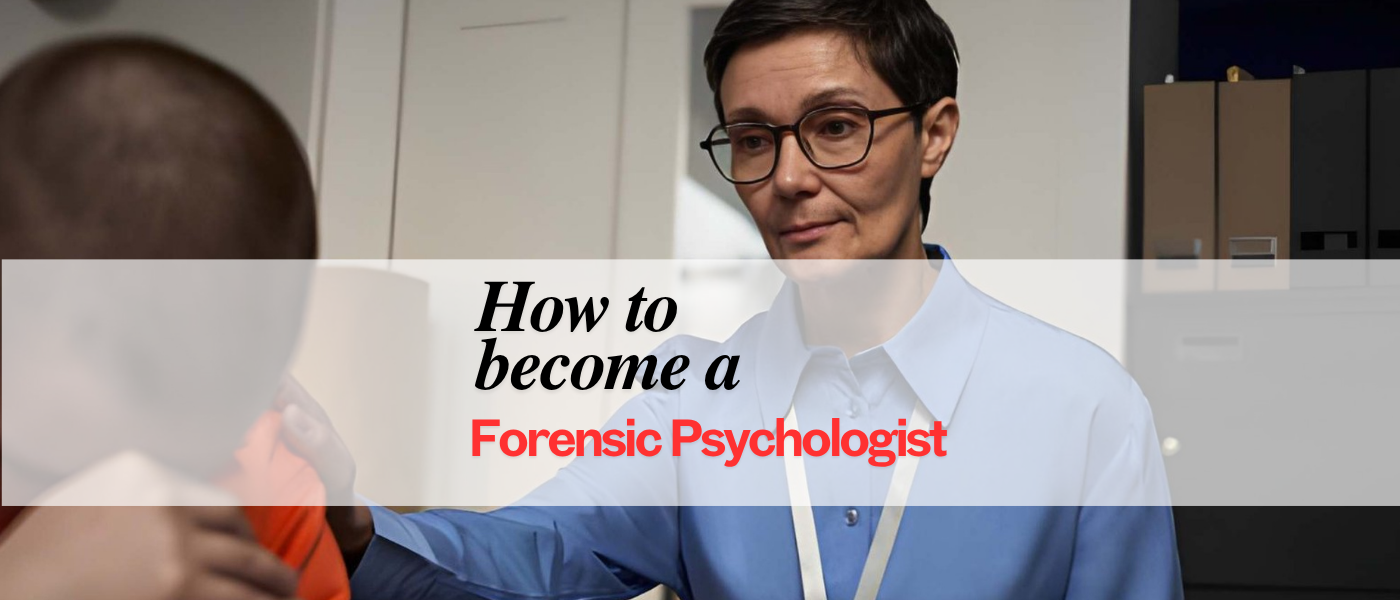
Forensic psychology is a sort of combination of both psychology and the law. It is the use of psychological knowledge to assist courts, law enforcement and correctional facilities in making better, more informed decisions. Forensic psychologists determine the mental competence of defendants, assess children in custody cases, create criminal profiles, and testify in serious criminal cases.
Every day, police and law enforcement agencies deal with cases where the mental health of offenders and victims plays an important role in making this a growing field in the USA. The U.S. Bureau of Labor Statistics estimates that psychologist jobs will grow 6% between 2024 and 2034, and about 12,900 vacancies annually.
And, in case this sounds like the type of work you would like to do, here is a step-by-step guide to becoming a forensic psychologist in the USA. It will cover how long it takes, what degrees you require, how much it costs, and what your career prospects will be like.
Key takeaways
- Forensic psychology combines psychology and law to help courts, police, prisons, and legal teams make better decisions.
- You typically require a bachelor’s degree, doctoral degree, supervised clinical hours, and state licensure to become a forensic psychologist in the USA.
- The entire process of becoming a forensic psychologist may take approximately 10-13 years, based on your course of study and state licensing necessities.
- Forensic psychologists can be involved in mental health assessments, court testimony, criminal profiling, victim support and rehabilitation planning.
- Salaries may depend on the state, level of experience, certification, and the work environment, with private practice typically having higher earning potential.
- This profession is on the rise due to the fact that the U.S legal system requires an increased number of professionals who would be knowledgeable in the areas of mental health, criminal behaviour, risk assessment, and rehabilitation.
What Does a Forensic Psychologist Do?
Before learning about becoming a forensic psychologist, it helps to understand exactly what the job involves day to day. Here is a breakdown of the most common roles and responsibilities:
Conducting Psychological Evaluations
Forensic psychologists carry out psychological assessments in criminal cases due to a number of reasons such as to identify possible motives or patterns. According to the APA dictionary, psychological assessment refers to checking a person’s mental health, behaviour, thinking ability, and emotional condition through interviews, tests, records, and observations.
It is done to establish whether the accused is a flight risk or not, and/or the defendant is fit to stand trial in court. These assessments have a direct impact on what occurs in a courtroom.
As an Expert Witness:
They are often called upon to testify against mental health matters or general theory and research in psychology and law. They are invited to give evidence about the mental condition of a person and its connection to the legal matter: disability, insanity, competency, or dangerousness.
In Jenkins v. United States, the defendant used testimony from three clinical psychologists to support an insanity defense. The case became important because the court considered whether psychologists could give expert opinions about a person’s mental disease or defect in court
Civil Case work:
Forensic psychology does not only apply to criminal law; it also deals with civil cases, such as family law cases (e.g., divorce or adoption), and juvenile cases that are not part of the adult criminal court system.
Support Victims and Offenders:
They are also connected directly with offenders and victims. They offer counseling services to offenders as part of their rehabilitation or support crime victims in coping with the psychological consequences of their experience.
Consulting with Law Enforcement
These psychologists are usually involved in criminal investigations by law enforcement agencies. This may include criminal profiling, which may assist in identifying possible suspects by analyzing behavioral patterns.
They apply the science of human behavior to each phase of the legal process, from investigation through sentencing to rehabilitation.
Step-by-Step Guide to How to Become a Forensic Psychologist in the USA
Here is a step-by-step guide on how to become a forensic psychologist in the USA if you plan on pursuing this career.
Step 1: Earn a Bachelor’s Degree
The first step is to get a bachelor’s degree. Most aspiring forensic psychologists earn a bachelor’s degree in forensic psychology, but you can also consider a criminal justice degree program with a psychology minor.
The best major is psychology, since it will provide the foundation you will need in graduate school. You will know how people think, feel, and act, and why some people break the law. If you are enrolling in a major in a criminal justice program, be sure to include psychology electives with it, as most graduate programs will require you to have that background.
Skills You Will Learn From Your Degree
Some of the undergraduate courses that will assist you in preparing are:
- Research skills: You will apply research skills throughout your career.
- Statistics: Basic to psychological studies and understanding.
- Abnormal psychology: Discusses mental illness and behavior, which is the focus of forensic work.
- Criminology: Helps you understand crime, criminal behaviour and the justice system.
These are your undergraduate forensic psychology education requirements. Maintain good grades, particularly in these core courses, as competitive doctoral programs will scrutinize your academic history.
Step 2: Gain Experience During Undergraduate Studies
Your degree is important, but it can be of great help to have some real-life experience as an undergrad. Graduate schools are competitive and experience makes the difference.
Look for opportunities to:
- Volunteer in local courts, juvenile justice programs, or community mental health centers.
- Apply for internships with law enforcement agencies, victim advocacy organizations, or youth detention facilities.
- Support research projects by assisting professors. This will teach you how to design research, gather data and interpret results, which are essential in graduate school.
Such experiences do not just strengthen your application. They also assist you in determining the area of forensic psychology that you are most interested in, be it in working with offenders, assisting victims, or conducting research.
Step 3: Earn a Master’s Degree
Many students take a master’s degree after your bachelor’s and then apply to doctoral programs. A master’s in forensic psychology enhances applications but is not a mandatory requirement. There are doctoral programs that are taken immediately after a bachelor’s degree.
The average time of a master’s degree is two to three years. You can choose between:
- A general master’s in psychology that provides you with a general foundation
- A specialization in forensic psychology, which goes directly to the crossroads of psychology and law
- Online courses, which are more flexible in case you are working during your studies
One of the most important things to know: a master’s degree will not make you eligible to practice as an independent forensic psychologist. While it’s possible to attain some roles in forensic psychology with only a master’s degree, obtaining a doctoral degree is necessary for advancement to the field’s highest levels.
A doctorate will be required in case you want to perform court assessments, become an expert witness, or establish your practice.
Step 4: Earn a Doctorate (PhD or PsyD) in Psychology
This is the greatest step in education. A doctoral degree (PhD or PsyD) in psychology with forensic specialization is required for independent practice as a licensed forensic psychologist.
Doctoral degrees can be of two kinds:
PhD (Doctor of Philosophy):
This is a degree that is very research-oriented. You will do original research, write a dissertation, and can spend a lot of time in an academic or scientific environment. A PhD would be a good option when you wish to teach at a university, do large-scale research, or work in policy, in addition to clinical practice.
PsyD (Doctor of Psychology):
This degree focuses more on clinical training and practical skills rather than research. It is oriented to the individuals who wish to work mainly with clients and patients. PhD is research-intensive and teaching and advanced assessment, whereas PsyD is clinical and best suited to practice.
Both degrees will have you do an internship and in the case of a PhD, a dissertation. Both also make you eligible for licensure.
Step 5: Complete Supervised Clinical Hours
You must prove that you can do the work, not merely study it, before you can get your license. This is where supervised clinical hours are involved.
In order to qualify as a forensic psychologist, you must have a doctoral degree, an average of 4,000 hours of clinical supervision, and a professional license. The number of hours required depends on the state, but most states have a range of 2,000 to 4,000 hours.
These hours are done in two phases:
- In your internship (part of your doctoral program): You are placed in a clinical environment under the supervision of a licensed psychologist.
- In a post-doctoral fellowship: Once you graduate, you do additional work under supervision, typically one to two years.
Typically these hours are spent in forensic psychiatric hospitals, correctional facilities, court clinics, and community mental health centers. These are not merely a prerequisite, they actually make you a competent, confident forensic psychologist.
Step 6: Get State Licensure
The EPPP is a two-part licensing exam developed by the Association of State and Provincial Psychology Boards (ASPPB). Part one will assess your knowledge in eight major fields of psychology. Part two is a test of practical skills. You will also probably have to take a state-specific jurisprudence test (a test on the laws and ethics of practicing psychology in your specific state), and in some states a background check.
This is one of the main aspects that many individuals are puzzled about: forensic psychology is a specialty that follows your general psychology license. You first become a licensed psychologist, and then you practice forensic work. The general licensure step cannot be skipped.
The requirements of licensing differ depending on the state, and therefore, you should always consult the psychology licensing board in your state to get the specific requirements in the state where you intend to practice.
Step 7: Pursue Forensic Specialization
After getting your license, you can officially fast track your pursuit of forensic psychology. This is the place where your career is actually formed.
At this point, the choices are:
- Post-doctoral fellowships in forensic psychology:
These are one- to two-year training programs that put you in a forensic environment such as federal prisons, forensic hospitals, or government agencies.
- Continuing education:
Most states have continuing education requirements to maintain your license, and there are numerous forensic-specific workshops, seminars, and courses.
- Optional board certification
Individuals seeking the forensic specialty can eventually become board certified by the American Board of Professional Psychology (ABPP). Forensics Colleges This is not a certification, but it indicates a high degree of expertise and may enhance your credibility in court, with employers and with clients.
The specialty of Forensic Psychology requires a minimum of 100 hours of qualifying specialized training in forensic psychology, acquired after the doctoral degree, as stated by ABPP. This can include approved continuing education or direct supervision by a qualified forensic professional.
Step 8: Start Your Career
Your license and specialization in your hands open the doors to a meaningful career. The entry-level jobs can be found in:
- Courts and court clinics
- State psychiatric hospitals
- Juvenile and correctional facilities.
- Government agencies
With experience, you can advance to higher positions like:
- Expert witness: Testifying psychologically in criminal and civil cases.
- Threat assessment specialist: The assessment of people who can be a threat in schools, workplaces, or other places.
- Private forensic consultant: This is an individual who works on their own with law firms, defense attorneys or corporations.
The career directions may include federal agencies such as the FBI, courts, correctional facilities, private practice, research institutions, and forensic mental health hospitals.
Forensic Psychology Salary and Job Outlook
Among the best things about the forensic psychology career is that the hard work will be rewarded both professionally and financially. The U.S. Bureau of Labor Statistics (BLS) classifies forensic psychologists as a sub-category of psychologists, all other, with a median annual salary of approximately $106,420, and top-paid earners of over 168,000+ annually.
-
State (Location)
The salaries differ greatly depending on the state because of demand and cost of living. According to BLS wage data for Psychologists, California had an annual mean wage of $134,360, Texas had $120,040, and Florida had $110,490. The Washington Alexandria metro area, which includes parts of Virginia, reported an annual mean wage of $113,330 for this category
-
Experience Level
Forensic psychology salaries can greatly be influenced by experience. The U.S. Bureau of Labor Statistics do not include pay based on specific years of experience. In place of this, BLS employs wage percentiles. It reported a median salary of $117,750 with lower earners around 47,450-76,550 and higher earners around $138,280- $157,420+ per year.
One of the largest sources of income is experience, and experienced professionals can earn twice as much as entry-level workers.
| Level | Salary Guide |
| Entry-level | $47,450–$76,550 |
| Mid-career | Around $117,750 |
| Senior | $138,280–$157,420+ |
-
Work Setting (Government vs Private Practice)
The salaries of forensic psychologists may differ greatly based on the working environment, i.e., government or private practice.
A survey in 2024 found that in institutions alone, the median income of forensic psychologists was equivalent to $110,000 in institutions alone. It was $148,000 in institutions and private practice, and $210,000 in private practice alone.
Government jobs are more predictable in regards to wages and benefits. For example, the Federal Bureau of Prisons hires forensic psychologists with GS-12 to GS-13 qualifications. Their base salary without locality pay ranges between $81,561 to $134,810 base salary.
Job Outlook (BLS Data)
The BLS estimates faster-than-average growth of 6% for psychologists between 2024 and 2034, with approximately 12,900 vacancies per year.
Forensic psychology in particular, gains in terms of expanded roles in:
- Criminal justice reform
- Court-based mental health assessments.
- Risk assessment and rehabilitation programs.
- Growing Demand
The demand for forensic psychologists is growing because of the growing awareness of mental health in the legal system and the necessity to provide expert testimony in court. They are essential in competency assessments, criminal profiling and rehabilitation planning, as they bridge psychology and law.
Is It Hard to Become a Forensic Psychologist?
The truthful response: yes, it is difficult but it is possible with the proper attitude, forensic psychology degree and training. The key issues are:
- Education and licensure: The full educational and licensure process requires 10-13 years, with a 4-year bachelor’s degree, a 5-7-year doctorate, and 1-2 years of supervised postdoctoral practice.
- Emotional exposure: You will be dealing with trauma survivors, criminal offenders, and highly disturbing case material on a regular basis. Emotional resilience is not a choice.
- Competitive programs: Doctoral programs in psychology are competitive with a small number of students being accepted annually, and applications are screened.
Who is it for?
- Aspirants seeking a profession where they could assist the courts, police, victims and offenders.
- Students who like learning about human behaviour, crime, mental health as well as decision-making.
- Individuals who feel at ease with research, interviews, report writing and court related work.
- Students who are prepared to follow an extended education journey, such as a doctoral degree and state licensure.
- Those who are able to remain calm and professional in handling serious crimes, trauma, and sensitive cases.
Ending thoughts
The path to becoming a forensic psychologist is not easy, yet it is very fulfilling. The process lasts 10-13 years and includes completing a bachelor’s degree, gaining practical experience, earning a master’s and doctoral degree, completing supervised clinical hours, passing the EPPP, and obtaining state licensure. It is then that you can specialize, become board-certified and have a career in the interesting overlap of psychology and the legal system.
The trick is to go in with realistic expectations. Yes, the path is long and the job is emotionally taxing–but forensic psychology has one thing that few professions can provide: the opportunity to apply science to the cause of justice. The need to have qualified professionals in this area is increasing and the difference you can make, to individuals, to communities and to the legal system is truly immense.
If this is the direction you desire, begin now. Find APA-approved programs, meet with professionals in the field, and contact your state psychology licensing board to learn the particular requirements in the area you intend to practice. Any long way begins with one step.
Frequently Asked Questions
Can I become a forensic psychologist with a criminal justice degree?
Yes, but you will first have to take some other prerequisites in psychology, including statistics, research methods, and abnormal psychology. Criminal justice majors are accepted in many graduate programs provided you can demonstrate related knowledge and experience in addition to those core courses.
How many years of school to be a forensic psychologist?
The average time to complete a doctoral program is four to seven years, depending on the program and your pace. Together with your bachelor’s and perhaps a master’s degree, you are facing a big time investment of 10-13 years, but it will surely result in a highly specialized and rewarding career.
Is a license required to be a forensic psychologist?
Yes — absolutely. Future forensic psychologists are required to take the Examination of Professional Practice in Psychology (EPPP). The EPPP is a state licensing exam developed by the Association of State and Provincial Psychology Boards (ASPPB). This step is necessary in all states and territories in the United States, and all provinces in Canada. American Military University
How to become a forensic psychologist for the FBI?
To work for the FBI as a forensic psychologist is competitive. You need a doctorate, a state license, years of post-licensure experience, and a clean background check. The majority of psychologists in the FBI are behavioral analysts or consultants, not traditional forensic psychologists.
Can forensic psychologists work remotely?
Some forensic psychology work can be done remotely, such as report writing, research, case review, and online consultations. However, more pressing matters like court testimony, psychological testing, prison work, and direct evaluations from victims and offenders often require in-person work.
Do forensic psychologists work with criminals or help the court?
Forensic psychology involves working with both the criminals and the courts. A big part of the job is helping the court understand the mental health of criminals and their behaviour, so that cases can be handled more fairly and accurately.


