

Cybercrime never sleeps. Billions of dollars is spent every day due to data breaches, ransomware attacks, identity theft, and digital fraud. The FBI Internet Crime Complaint Center reported that the US alone reported more than $20.8 billion in cybercrime losses in 2025. Cybercrime is projected to cost the world $10.5 trillion a year. Such figures indicate that there is a tremendous demand for digital forensics specialists.
Businesses, governments, and police departments are always looking for skilled people who can help stop hackers. These experts also help recover important evidence and protect computer systems from future attacks. Have you ever wondered what it would be like to work like a digital detective? Someone who follows clues, tracks hackers, and studies online crime scenes? If yes, then digital forensics could be the right path for you.
This guide will explain everything you need to know about digital forensics careers, including what the job involves, how to start, and how much money you can earn.
Key Takeaways
- Cybercrime is rising so fast that digital forensics has become a critical addition to companies, and law enforcement. Experts are needed to trace attacks, recover evidence, and explain exactly what happened.
- Digital forensics is not an IT job since it involves technical investigation, law, and cybersecurity. Professionals investigate devices, retrieve deleted information, and convert the results to evidence that can be used to substantiate actual cases.
- The profession has diverse career opportunities, including cybercrime investigations, mobile forensics, network analysis, and e-discovery. This allows them to specialize in areas that are practical and in demand.
- Getting into digital forensics usually requires a mix of education, certifications, and hands-on technical experience. Employers desire individuals who are knowledgeable about tools, systems, and real-life investigative procedures.
- Attention to detail, legal awareness, and handling of evidence are as important as technical skill in this field. Any minor error in documentation or the chain of custody can undermine the whole investigation.
- Digital forensics is a well-paying profession, with a stable career, and a promising future as AI, cloud, crypto, and IoT continue to transform cyber investigations. It is a clever choice for any person who wants to do meaningful work in a rapidly developing sphere.
What is Digital Forensics?
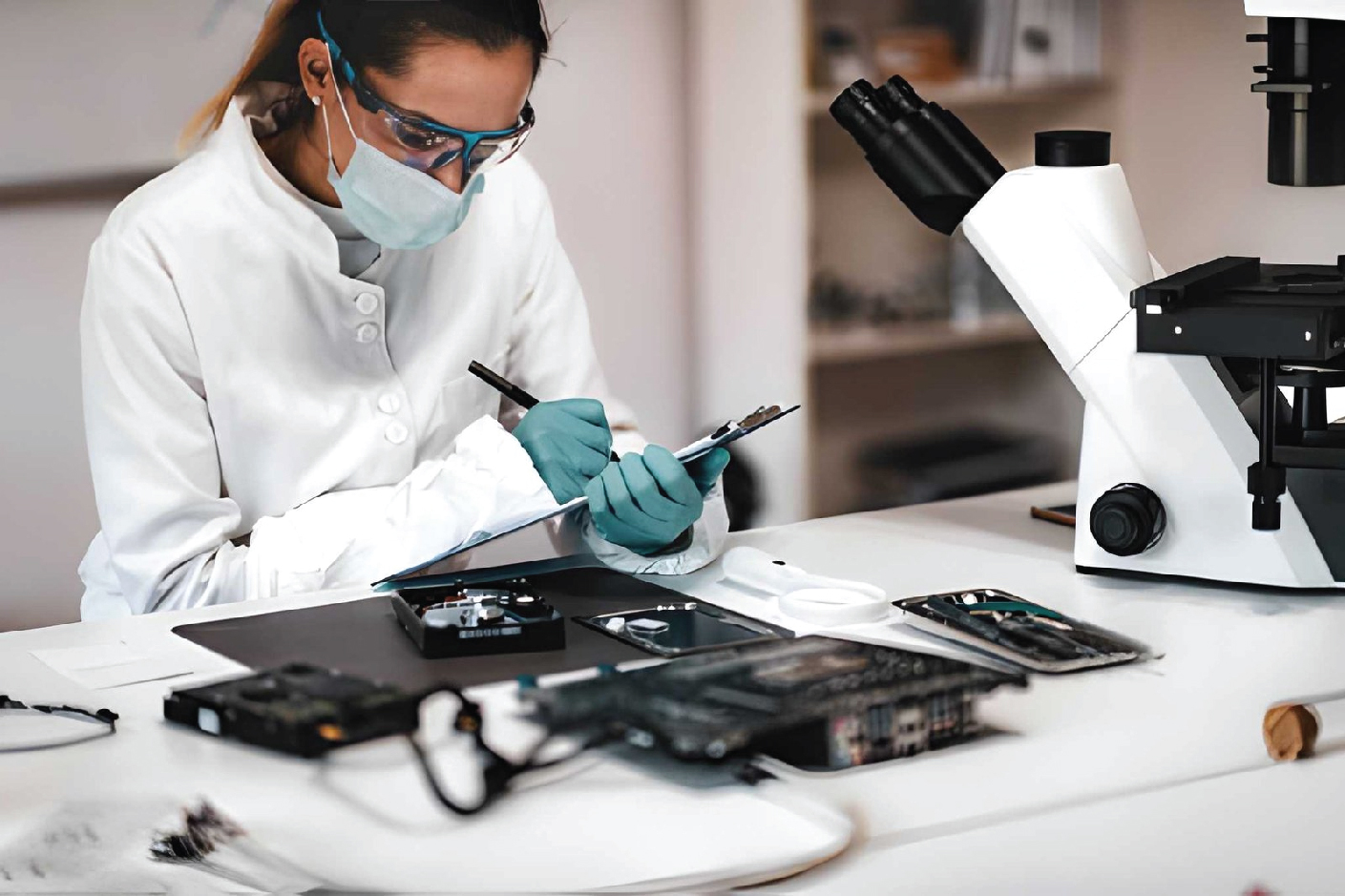
Digital forensics refers to the act of gathering, maintaining, examining, and reporting on electronic evidence on computers, smartphones, networks, and other digital devices. Imagine it as a crime scene investigation–except that you are working with deleted files, encrypted data, browser history, and network logs. A digital forensics expert, also known as a digital forensic analyst or cyber defense forensics analyst, is a specialist who is trained to retrieve data that has been deleted by criminals. They do this by identifying the source of a cyberattack and presenting the results in a manner that can be accepted in court. The discipline is at the intersection of forensic science, cybersecurity, technology, law enforcement, and . The professionals in digital forensics are employed by federal agencies such as the FBI and Secret Service, local law enforcement agencies, corporations, law firms, and cybersecurity consulting firms.
To get a better idea of the bigger picture of forensic science careers, skills and salary, please check out Forensic Science Careers, Jobs, Skills and Salaries.
New Jobs in Cyber Forensics
The internet revolution has brought about completely new types of crime and in result, has created completely new types of criminal investigators to combat them. The following are some of the most sought-after positions these days:
Cybercrime Investigator
A cybercrime investigation career involves an investigator who mainly works with the law enforcement or government agencies to investigate crimes that occur online or those that involve the use of digital devices. This involves hacking, internet fraud, identity theft, child exploitation, and cyberstalking. They collect electronic evidence, question witnesses, and collaborate with prosecutors to construct criminal cases.
One such example of this role is the 2025 DOJ case in which the FBI took years to track down 12 Chinese nationals. This includes government officers, who had been hacking U.S. organizations, religious groups, and foreign ministries in Asia. It does not get any higher stakes than that.
Digital Forensic Analyst
This is the main role in the field. A digital forensic analyst investigates hard drives, computers, smartphones, and other devices to retrieve and analyze information. They restore lost files, monitor user actions, and prepare comprehensive reports on their findings. These practitioners are employed in the government (police departments, federal agencies) and the business (corporations, consulting firms).
A well-known case in point is the Silk Road case. The forensic analysts were able to extract chat logs, financial documents, and even a personal journal from the laptop Flashback Data of Ross Ulbricht, which was used to close the case. More recently, organizations that have fallen victim to data breaches have been hiring forensic analysts regularly to assemble a complete picture of what occurred.
Mobile Device Examiner
Mobile device examiners have become a necessity as smartphones have become the main computing device for billions of people. They are experts at retrieving information from iPhones, Android phones, tablets, and wearable devices, including text messages, call logs, GPS location data, app usage, and even deleted photographs.
With the extent to which contemporary life occurs on a phone, mobile forensics has emerged as one of the most important specializations in the profession.
Numerous cases have been reported where investigators were able to retrieve deleted videos on the phone of a murder suspect that directly connected him to the murder. According to one forensic expert, cell phones have become the new modern DNA in criminal investigations. Read these case studies on the Cellebrite site.
Network Security Specialist
These experts are concerned with the research of network-based attacks. Once a company is hacked, a network security expert examines firewall logs, intrusion detection system logs, and network traffic to determine how the attacker gained access, what they accessed, and how to ensure that it does not occur again. This position is very similar to incident response.
Every major breach you read about in the news involves this kind of work behind the scenes. Such as the 2025 Qantas breach, which revealed 5.7 million customer records, was fully comprehended through forensic network analysis. Experts tracked precisely how attackers traversed the systems of a third-party vendor.
E-Discovery Specialist
E-discovery (electronic discovery) is the process of locating, gathering, and generating electronically stored information to be used in a legal case. E-discovery specialists work with law firms and corporate legal departments to sift through vast amounts of emails, documents, and database records in response to litigation or regulatory investigations. It is a fast-expanding field because all business communication is now done digitally.
Over 90% of records produced today are digital, and this implies that virtually every big lawsuit today has a significant e-discovery element. It has whole departments in large law firms, and the number of specialists in demand is increasing rapidly.
How Is Life as a Digital Forensic Investigator?
Digital forensics is a truly unique profession compared to most other technology jobs. It is a blend of the precision of lab work with the intellectual challenge of puzzle solving and occasionally, the emotional burden of working on serious crimes.
An average day may include being handed over a confiscated hard drive by the police, making a forensic image of the device, executing analysis software to salvage deleted data, compiling a chain of custody, and producing a technical report that may be presented in court. There are no two cases that are identical.
Corporately, investigators may be invited to the company following a data breach to find out what occurred, the extent to which the attacker accessed the network, and what information was stolen. Regulations like GDPR, HIPAA, and SOX all mandate incident documentation with an appropriate chain of custody – and insurers now insist on forensic reports prior to paying out cyber claims. The work can be very high-pressure and fast-paced, particularly in incident response situations where companies require answers fast.
The profession is also emotionally taxing, especially to the individuals in the law enforcement department who might be exposed to evidence of child exploitation, violent offenses, or terrorism on a regular basis. Support systems and peer networks are important for professionals in those roles.
On the upside, the majority of the professionals in this sphere report that their work is very meaningful and thought-provoking. The employment market is very robust, employment is secure, and the wages are competitive. There is also an increasing number of remote work opportunities, particularly in the private sector and consulting.
How to Become a Digital Forensic Investigator?
There is no one strict route to join this profession, but the following are the most popular and efficient:
Step 1: Get a good IT foundation
Get a solid foundation in computer science, networking and operating systems. Many digital forensics professionals have experience as IT support, network administrators or cybersecurity analysts.
Step 2: Get a related degree
A bachelor of cybersecurity, forensics, computer science or criminal justice is the most common educational pathway. According to O*NET OnLine’s (2015) data, 53% of information security analysts hold a bachelor’s degree. Forensics Colleges.
Step 3: Have practical experience
Internships and practical experience in a home lab or initial IT jobs are key. Employers are looking for practical experience in using forensic tools.
Step 4: Earn certifications
Having certifications in the field increases your job prospects and earnings. The most well known are GCFA (GIAC Certified Forensic Analyst) and GCFE (GIAC Certified Forensic Examiner).
Step 5: Specialize and practice
Initial positions include junior forensic analyst, IT support specialist working with a law enforcement organisation or cybersecurity expert. As you gain more experience, you can specialise in mobile forensics, cloud forensics or malware analysis.
What Skills Are Needed for Digital Forensics in Cyber Security?
There are specific technical, investigative and legal skills required for digital forensics. Here are some of the skills you must learn in this field:
@infosecdany Lets chat about digital forensics! Here I talk about what I have learned in my classes! #cyber #cybersecurity #cybersec #infosec #cybersecuritynews #cybersecuritytraining #cybersecuritymajor💻📱💾 #cybersecurityservices #cybersecurityawareness #cybersecurityexpert #cybersecengineer #engineer #engineering #womenintech #womeninstem #girlsintech #girlsinstem #stem #tech #technology #techie #techgirls ♬ original sound – Dany
Operating System Knowledge. Be familiar with Windows, Linux and macOS file systems. Know how to locate evidence in these operating systems as a digital forensic investigator.
Forensic Tool Proficiency. Know how to use tools such as EnCase, Autopsy, FTK (Forensic Toolkit), Cellebrite (mobile), Volatility (memory analysis) and Wireshark (network analysis).
Networking Fundamentals. Understanding of TCPIP protocols, DNS, firewalls and networking is required to properly investigate cyber attacks.
Legal Knowledge. Knowledge of the rules of evidence and court procedure is essential. Understand the collection and presentation of evidence.
Programming and Scripting. Being proficient with Python, Bash or PowerShell can help investigators to automate tasks or process large collections of data.
Malware Analysis. The ability to detect and analyze code can help experts to understand the methods and damage of hackers.
Critical Thinking and Attention to Detail. Computer investigations are time-consuming and require careful reasoning. Learn to observe and identify anomalies in large data sets.
Mobile and Cloud Forensics. Cellular and cloud forensics are in high demand. People with these skills have a good chance of earning high salaries and receiving job offers.
Degrees and Certifications That Matter in Digital Forensics
How to Get a Digital Forensics Degree?
Digital forensics, cybersecurity, or computer science bachelors is normally a four-year program. Certain universities have specific digital forensics degrees that combine technical education with criminal justice studies. Get a detailed overview of the available degree options in forensic science in this guide.
Certifications are often more important than degrees when it comes to getting hired in digital forensics. The most recognized ones include:
GCFE – GIAC Certified Forensic Examiner: This is a certification related to Windows forensics.
GCFA – GIAC Certified Forensic Analyst: A more advanced certification that combines network forensics, memory analysis and incident response.
CCE – Certified Computer Examiner (ISFCE): It is one of the oldest and most established forensic certifications, accepted by law enforcement agencies worldwide.
EnCE – EnCase Certified Examiner: Certifies knowledge of the EnCase forensic platform, which is popular in law enforcement and corporate investigations.
CFCE – Certified Forensic Computer Examiner (IACIS): This is a very prestigious certification in the law enforcement community, and it has a very strict practical examination component.
CompTIA Security+: A general cybersecurity certification that provides a helpful base to forensics careers and is often used as a minimum by employers.
CISSP – Certified Information Systems Security Professional: This is a high level qualification that is useful in senior and leadership positions.
CEH – Certified Ethical Hacker: Learning how attackers think is highly beneficial to digital forensic investigators who must be able to recreate intrusions.
Salary Expectations in Digital Forensics
The digital forensics field has a high salary expectation. The Federal labor statistics show that the field has competitive pay. The US Bureau of Labor Statistics reports that Information Security Analysts had a median annual income of $124,910 in May 2024, with the lowest 10% earning under $69,660 and the highest 10% earning over $186,420.
Salaries vary significantly by role, experience level, employer type, and location. Here are some you can check out.
| Role | Current Salary Data | Source |
| Information Security Analyst | $124,910 | BLS |
| Digital Forensics Analyst | $69,664 average salary | Salary.com |
| Digital Forensics Analyst I | $102,500 average salary | Salary.com |
| Digital Forensic Investigator | $71,203 average salary | Salary.com |
| Cyber Forensic Analyst | $79,360 average salary | Salary.com |
| Cybercrime Investigator | $70,123 average salary | ZipRecruiter |
| Network Security Specialist | $80,093 average salary | ZipRecruiter |
| eDiscovery Specialist | $72,300 average salary | Salary.com |
| Cyber Defense Analyst | $96,554 average salary | Salary.com |
Challenges and Ethical Dilemmas You’ll Face in Digital Forensics
Digital forensics is no doubt a rewarding career, yet it has its real challenges, which the aspiring professionals should be aware of before deciding to take this on.
-
Volume and Complexity of Data
Modern research means terabytes of data spread across multiple devices, cloud services and applications. Digital forensics is the task of looking for smaller and smaller needles in a bigger and bigger haystack.
-
Privacy vs. Investigation
The digital forensics specialists often have access to the most private parts of the digital lifestyles of individuals, their private communications, search records, photos and bank accounts. The need to weigh up the right to evidence against the right to privacy of the person is an ongoing ethical challenge, especially when dealing with such laws as GDPR and HIPAA.
-
Legal and Jurisdictional Issues
Cyberattacks are often transnational in nature. A server located in one jurisdiction, an offender in another and a victim in a third raises complex legal questions of jurisdiction, ownership of data and cross-border co-operation.
-
Staying up-to-date with Technology
The ever evolving technology requires investigators to continually upgrade their knowledge and expertise. Modern encryption techniques and anti-forensic software are designed to defeat forensic investigations.
-
Emotional Toll
It can be a grave psychological toll, particularly for those working with child pornography, terrorism, or extreme violence.
-
Chain of Custody Risks
Any mistake in the handling, storage or documentation of evidence can make it inadmissible in court and can be disastrous. There is a very small margin for error.
How AI, Cloud, and Crypto Are Reshaping Forensics
Digital forensics is an ever changing technology. There are many technologies that are transforming the way investigators work. Like these:
Machine Learning and Artificial Intelligence
AI is quickly changing law enforcement and digital forensics, enabling investigators to handle huge amounts of data, solve cases faster, and keep officers out of traumatic content. Machine learning models can automatically categorize images, indicate suspicious activity in network logs and detect malware patterns instantly. Plus, they can analyze thousands of text messages to bring up relevant evidence in minutes.
Forensic platforms are now being directly integrated with large language models. Tools such as BelkaGPT enable investigators to pose plain-language queries. Such as “Can you find anything suspicious and get results based on case data,” a radical change in the old-fashioned command-line analysis. Although AI does not substitute human digital investigators but enhances their capacity to work with complicated, data-intensive cases.
Cloud Forensics
With the increasing transfer of data to the cloud, such as AWS, Microsoft Azure, and Google Cloud, digital forensic investigators need to acquire specialized skills to obtain and analyze cloud-based evidence. To overcome the challenges of cloud environments and service provider architectures, investigators require specialized skills and tools.
This is one of the most dynamic areas in the field as the legal frameworks surrounding cross-border cloud data access continue to evolve.
Cryptocurrency and Blockchain Investigations
Cryptocurrency is becoming more and more important in ransomware payments, dark web transactions, and money laundering schemes. An emerging subspecialty is the tracking of cryptocurrency transactions, the de-anonymization of wallet addresses, and the creation of financial evidence trails on blockchain networks.
Law enforcement agencies and financial institutions hire digital investigators who have blockchain forensics skills.
IoT Forensics
The spread of smart devices, including wearables and smart home appliances, poses new forensic challenges. The process of obtaining and processing data on these various devices involves specialized skills and techniques.
GPS logs of a fitness tracker could implicate a suspect at a crime scene. The logs of the usage of a smart thermostat may prove or disprove an alibi. IoT forensics is a new field where there are very few qualified practitioners, which makes it a great field to grow in for talented analysts.
Why Should Students Consider Cyber Forensics?
As a student who is attempting to make this career choice, digital forensics presents a truly interesting blend of variables that are difficult to encounter in most other professions:
The demand in this field is projected to increase by 29% between 2024 and 2034, which is incredibly rapid- more than 52,100 jobs are projected to be created in the same time frame. Qualified professionals in Forensics Colleges are already scarce, and that is only increasing.
Forensic analysts at the entry-level earn between $50,000 and $70,000, and within a short time, they can rise to six-figure salaries as experience and certifications build up. The work is very meaningful. Digital forensics specialists assist in putting criminals in jail, safeguarding innocent individuals against cyber attacks, retrieving stolen property, and serving justice.
The profession is also intellectually stimulating. There is no case that is similar; technology is dynamic, and learning is an ongoing process.
The entry paths to this career are various. You can enter with a degree in computer science, a degree in criminal justice, a cybersecurity certification, or even by serving in the military in a cyber operations position. And the work of forensic consulting and e-Discovery in the private sector is becoming more remote-friendly, with geographic flexibility that many more traditional professions cannot afford.
How to Become a Cyber Defense Forensics Analyst?
The U.S. Department of Defense and other agencies use the title Cyber Defense Forensics Analyst in the private industry as well. It defines a professional who is both proactive in cyber defense and has the ability to conduct forensic investigations, someone who is not only able to respond to an incident once it occurs but also be able to prevent it.
In the United States, the average salary of a Cyber Defense Forensics Analyst is $101,608 per year, with most salaries falling between $78,500 and $132,000, and highest paid employees earning $148,500 per year.
The following is a specific roadmap towards this position:
-
Obtain a Bachelor’s Degree
Excellent options include computer science, cybersecurity, information technology, or digital forensics. Numerous Cyber Defense Forensics Analyst jobs, especially government and DoD jobs, demand at least a four-year degree.
-
Develop Fundamental Technical Expertise
Focus on networking (TCP/IP, firewalls, VPNs), operating systems (Windows and Linux), and programming fundamentals (Python, Bash). These are the building blocks of the role that cannot be compromised.
-
Obtain Key Certifications
CompTIA Security+ is a popular minimum requirement. There, follow GCFA or GCFE. For DoD jobs, it is frequently required to meet DoD 8570/8140 certification requirements.
-
Gain Incident Response Experience
Cyber defense forensics analysts are often summoned when security incidents are underway. Practice in a Security Operations Center (SOC) or as a junior incident responder is a great preparation.
-
Apply to First-Level Jobs
Search using the terms junior forensic analyst, cybersecurity expert, incident response analyst, or SOC analyst. Entry-level analysts are often employed by government contractors who serve DoD or intelligence agencies.
-
Seek a Security Clearance Where Necessary
A U.S. security clearance (Secret or Top Secret/SCI) is required in many of the best-paying Cyber Defense Forensics Analyst jobs. By starting this process at an early age, usually with the help of a DoD contractor employer, you greatly increase your career choices and income potential.
Final Thoughts
Cybercrime is not slowing down and neither is the need to have professionals capable of combating it. Digital forensics combines the best of technology, law, and investigation, offering meaningful work, good pay, and job security that few professions can match.
The potential is real, and the timing could not be any better. This is a field to consider whether you are a student trying to find a career path or a tech professional seeking a more meaningful path. Begin low, develop your abilities, get your certifications, and step by step. The cyber world requires protectors, and that is where digital forensics occurs.
FAQs
Is there a demand for digital forensics?
Absolutely. The digital forensics market is projected to grow to $46.1 billion by 2035, as compared to 15.7 billion in 2025, with the continued growth of cloud computing, IoT devices, and AI-powered tools. Combined with the 29% estimated job growth rate in related positions, demand is strong and growing.
Is digital forensics a good career for science graduates?
Yes, very much so. Digital forensics can be a great fit for science graduates, especially those with a background in computer science, information systems, mathematics, or even chemistry. The discipline values critical thinking, systematic research, and scientific discipline.
What degree is best for a career in cyber forensics?
Most jobs have the best foundation in a bachelor’s degree in digital forensics, cybersecurity, or computer science. Certain jobs, especially those in law enforcement or e-discovery, also require a degree in criminal justice with technical certifications. A graduate degree in cybersecurity or digital forensics can lead to senior positions and leadership at the graduate level.
Do digital forensic experts work for the FBI?
Yes. The FBI hires digital forensics examiners as special agents, who are technically specialized, and as professional staff (non-agent) positions. The Regional Computer Forensics Laboratories (RCFLs) of the FBI are spread throughout the nation and deal with federal cases. The Secret Service, DHS, NSA, and the Department of Defense Cyber Crime Center (DC3) also employ digital forensics professionals.
What’s the difference between cybersecurity and digital forensics?
Cybersecurity is more about attack prevention, creating defenses, threat monitoring, and system security. Digital forensics is concerned with the post-incident actions, such as investigating the incident, preserving evidence, identifying offenders, and recording the evidence to be used in court. Practically, the two disciplines overlap a lot.


